
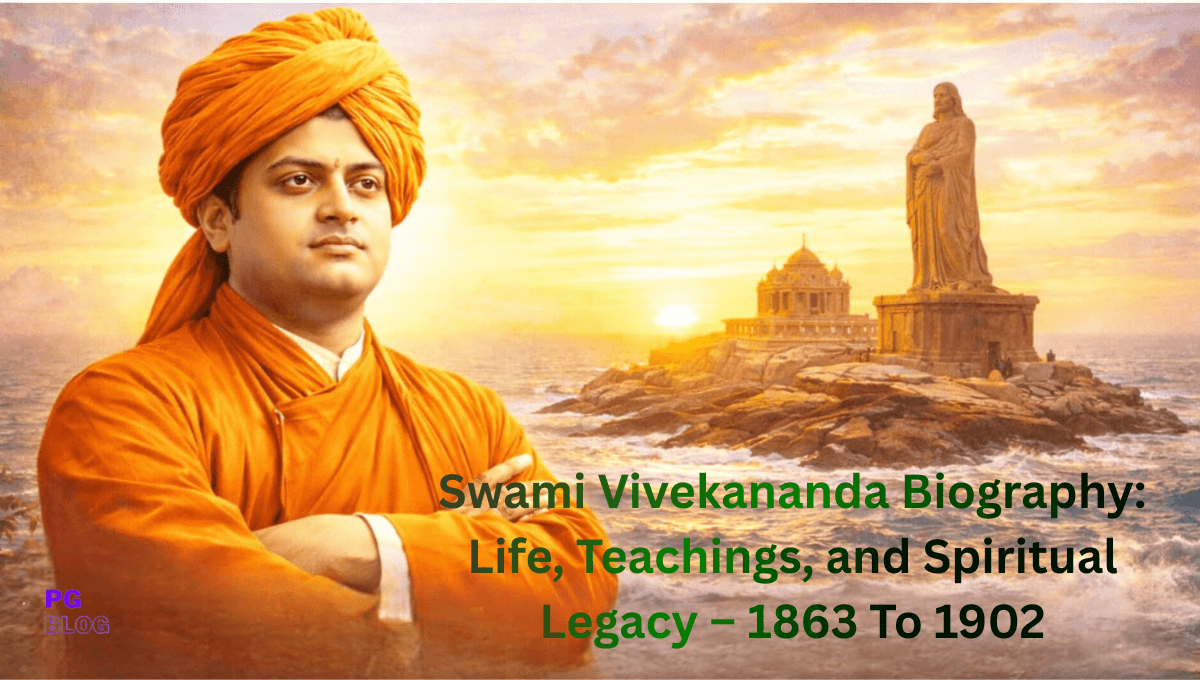
Swami Vivekananda stands as one of the most influential spiritual leaders and thinkers India has ever produced. A torchbearer of Vedanta philosophy and an ambassador of Indian spirituality to the world, Swami Vivekananda inspired millions with his powerful words, fearless ideas, and deep faith in human potential. His life story is not just a biography but a guide for self-belief, discipline, and service to humanity.
More than a monk, “Swami Vivekananda” was a reformer, philosopher, patriot, and visionary who awakened India from centuries of social inertia and presented its spiritual wisdom to the global stage. Even today, his teachings continue to motivate youth, leaders, and seekers across the world.
More than a century after his passing, Swami Vivekananda’s teachings continue to inspire millions across the globe, motivating people to lead a life of strength, service, self-belief, and spiritual awareness. This biography explores his life journey, philosophy, teachings, and the timeless spiritual legacy he left behind.
This blog explores Swami Vivekananda’s life, education, spiritual journey, teachings, achievements, and lasting legacy, offering a complete and inspiring biography.
Table of Contents
Early Life of Swami Vivekananda
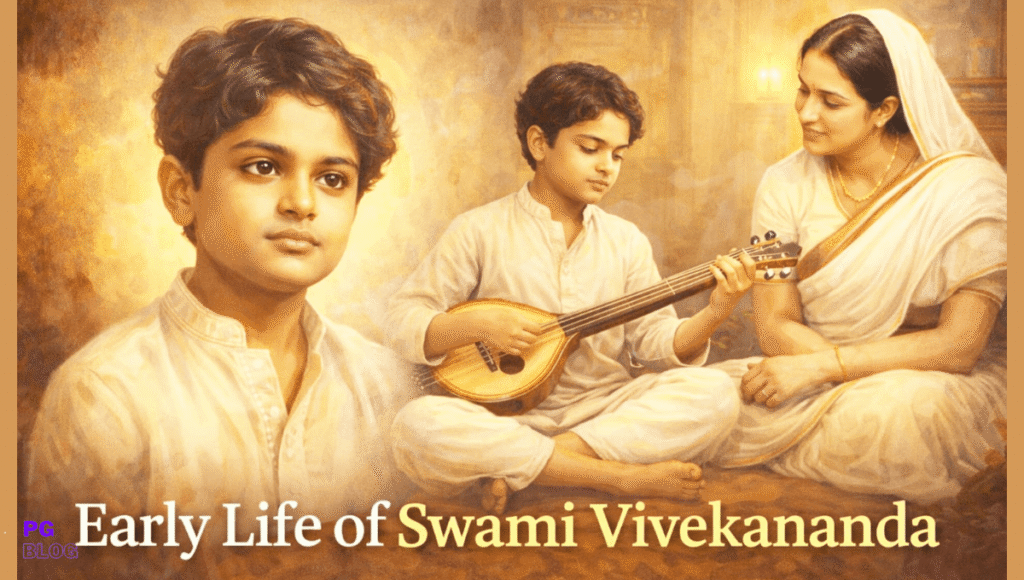
“Swami Vivekananda” was born on 12 January 1863 in Calcutta (now Kolkata), during British rule in India. His birth name was Narendranath Datta. He was born into an educated and progressive Bengali family.
His father, Vishwanath Datta, was a successful attorney in the Calcutta High Court and possessed a rational, liberal outlook. His mother, Bhuvaneshwari Devi, was deeply religious and spiritually inclined, whose devotion and strong character had a profound influence on young Narendra.
From an early age, Narendra displayed exceptional intelligence, courage, and curiosity. He questioned religious rituals, challenged blind faith, and sought truth through reason. His childhood was marked by deep interest in music, philosophy, literature, and physical fitness.
Education and Intellectual Development
Narendranath received his early education at the Metropolitan Institution, where he excelled in academics. Later, he studied at Scottish Church College, where he was exposed to Western philosophy, logic, science, and history.
He studied thinkers such as:
Immanuel Kant
David Hume
Herbert Spencer
John Stuart Mill
At the same time, he immersed himself in Indian scriptures like the Upanishads, Bhagavad Gita, Ramayana, and Mahabharata.
Despite his intellectual brilliance, Narendra was restless. He struggled with spiritual doubts and constantly asked a fundamental question:
“Have you seen God?”
These questions led him to many saints and spiritual leaders, but none satisfied him—until he met Sri Ramakrishna Paramahamsa.
This intense longing for direct spiritual experience became the turning point of his life.
Meeting with Sri Ramakrishna Paramahamsa
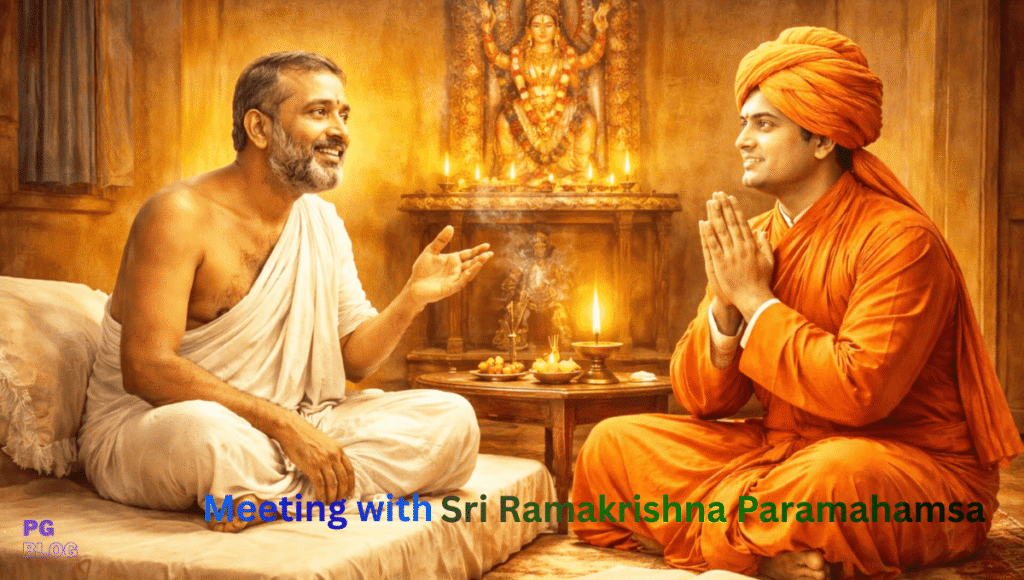
Narendranath’s spiritual quest led him to Sri Ramakrishna Paramahamsa, a mystic saint of Dakshineswar Kali Temple. Initially skeptical, Narendra tested Ramakrishna with rational arguments. However, Ramakrishna’s simplicity, spiritual depth, and direct experience of God deeply impressed him.
Sri Ramakrishna answered Narendra’s question with confidence:
“Yes, I see God as clearly as I see you.”
This encounter transformed Narendra’s life. Under Ramakrishna’s guidance, he realized the unity of all religions and the divinity inherent in every human being.
Under Ramakrishna’s guidance, Narendra underwent intense spiritual training. He experienced moments of deep meditation, inner awakening, and self-realization. Ramakrishna taught him that all religions lead to the same truth, a principle that later became central to Vivekananda’s teachings.
After Sri Ramakrishna’s passing in 1886, Narendra took monastic vows along with other disciples, eventually renouncing worldly life to pursue spiritual realization, becoming Swami Vivekananda.
Becoming Swami Vivekananda
After years of intense meditation and spiritual discipline, Narendra emerged as Swami Vivekananda, a wandering monk (parivrajaka). He traveled extensively across India on foot, witnessing the poverty, suffering, and social inequality faced by the masses.
These experiences shaped his vision:
Spirituality must serve humanity
Religion should uplift society
Strength and fearlessness are essential for progress
He believed India’s downfall was due not to lack of spirituality but lack of self-confidence and unity.
Chicago Speech 1893: How Swami Vivekananda Changed the World
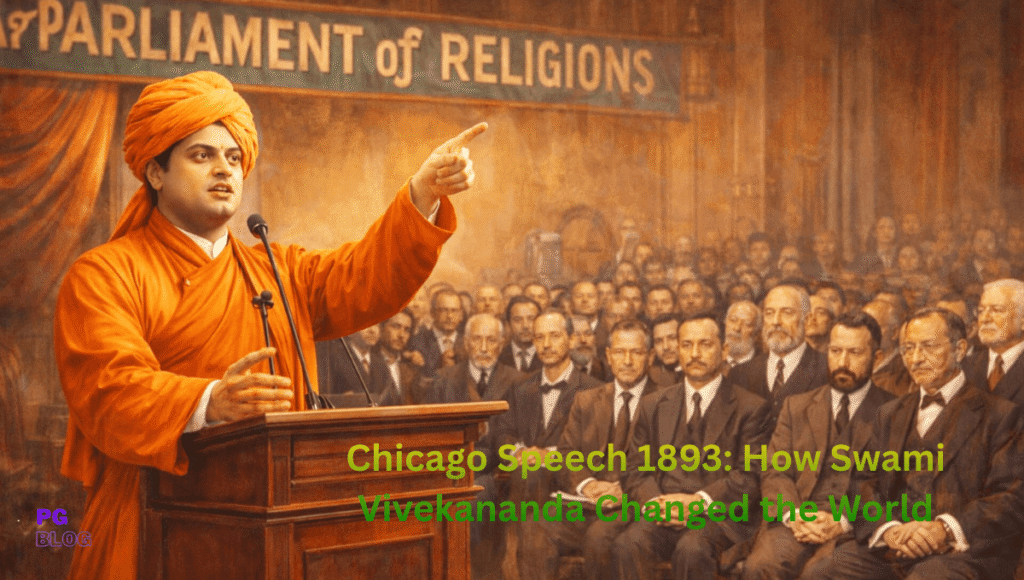
On September 11, 1893, at the World’s Parliament of Religions in Chicago, a young monk from India stepped onto a global stage and uttered words that would echo through history:
When he began his speech with the words:
“Sisters and Brothers of America,”
Those five words, spoken by Swami Vivekananda, earned him a standing ovation and instant recognition across the Western world. At a time when India was under colonial rule and Eastern philosophies were misunderstood, Swami Vivekananda proudly presented Vedanta, Hindu philosophy, and the spiritual wisdom of India to the world.
Unity of all religions
Acceptance rather than tolerance
Service to humanity as service to God
This event established Swami Vivekananda as a global spiritual leader and brought Indian philosophy to the world stage.
Teachings and Philosophy of Swami Vivekananda
Swami Vivekananda’s teachings are practical, powerful, and timeless. They address both spiritual growth and social responsibility.
- Divinity of the Soul
He believed every human being is divine and capable of infinite growth.
“Each soul is potentially divine.”
- Strength and Fearlessness
He emphasized physical, mental, and moral strength.
“Strength is life, weakness is death.”
- Universal Religion
Vivekananda taught that all religions lead to the same truth and should coexist peacefully.
- Service to Humanity
He believed serving the poor and oppressed is the highest form of worship.
“They alone live who live for others.”
- Education for Character Building
He advocated education that builds character, confidence, and self-reliance, especially among youth.
Founding of the Ramakrishna Mission
In 1897, Swami Vivekananda founded the Ramakrishna Mission to carry forward Sri Ramakrishna’s spiritual ideals combined with social service.
The mission focuses on:
Education
Healthcare
Disaster relief
Spiritual teaching
Rural development
Today, the Ramakrishna Mission operates across India and globally, serving millions irrespective of caste, creed, or religion.
Role in Indian National Awakening
Although Swami Vivekananda was not directly involved in politics, his teachings played a crucial role in India’s freedom movement. Leaders like Mahatma Gandhi, Subhas Chandra Bose, sardar vallabhbhai patel, and Jawaharlal Nehru drew inspiration from his ideas.
He instilled:
National pride
Cultural confidence
Faith in India’s spiritual heritage
His call ignited a new sense of nationalism and self-respect among young Indians
Swami Vivekananda and Youth Empowerment
Swami Vivekananda had immense faith in the youth of India. He believed that they were the architects of the nation’s future.
“Give me a hundred strong youth and I will change India.”
He encouraged the youth to:
Develop discipline and character
Serve society selflessly
Balance spirituality with action
To honour his vision for youth empowerment, his birthday, January 12, is celebrated as National Youth Day in India.
Books and Literary Contributions
Swami Vivekananda was a prolific writer and speaker. His works continue to inspire millions worldwide.
Notable books include:
Raja Yoga
Karma Yoga
Bhakti Yoga
Jnana Yoga
Complete Works of Swami Vivekananda
His writings combine deep philosophy with practical wisdom, making spirituality accessible to all.
Final Years and Mahasamadhi “Swami Vivekananda”
Swami Vivekananda’s life, though short, was intense and impactful. He attained Mahasamadhi on 4 July 1902, at the age of 39, at Belur Math.
Despite his early departure, his mission, message, and inspiration continue to live on.
FAQs on Swami Vivekananda
Who was Swami Vivekananda?
Swami Vivekananda was an Indian Hindu monk, philosopher, and spiritual leader who played a key role in spreading Vedanta and Yoga to the Western world.
What was the real name of Swami Vivekananda?
His real name was Narendranath Datta.
When and where was Swami Vivekananda born?
He was born on 12 January 1863 in Kolkata, India.
Who was Swami Vivekananda’s guru?
His spiritual guru was Sri Ramakrishna Paramahamsa.
Why is Swami Vivekananda famous?
He is famous for his Chicago speech in 1893, his teachings on self-confidence and spirituality, and for founding the Ramakrishna Mission.
What did Swami Vivekananda teach?
He taught self-belief, strength, unity of religions, service to humanity, and practical spirituality based on Vedanta.
What is the Ramakrishna Mission?
The Ramakrishna Mission is a spiritual and humanitarian organization founded by Swami Vivekananda in 1897, focusing on education, healthcare, and social service.
What are the famous quotes of Swami Vivekananda?
One of his most famous quotes is:
“Arise, awake, and stop not till the goal is reached.”
When did Swami Vivekananda die?
He passed away on 4 July 1902 at the age of 39.
Why is National Youth Day celebrated on 12 January?
National Youth Day is celebrated on Swami Vivekananda’s birth anniversary to honor his vision for youth empowerment and character building.
